While traveling the last few months, I've been listening to Pema Chödrön's audiobook Getting Unstuck: Breaking Your Habitual Patterns and Encountering Naked Reality. In it, she tells a story of the Dalai Lama that I found so profound. An older monk came to the Dalai Lama for advice on whether or not to take up a new yoga practice that was physically very strenuous. The Dalai Lama advised him not to, because of his age and the physical exertion required. The next day, the man committed suicide, because he believed that if he died he would be reborn into a younger body and could then complete the yoga practice that was so important to his religious beliefs.
 The Dalai Lama was left with grief and regret about his responsibility for the man's death. But when a journalist so taken aback by this story asked him, "How did you ever get rid of that feeling?" the Dalai Lama paused and then responded: "I didn't. It's still there. I just don't allow it to drag me down and pull me back."
Pema Chödrön uses this story to illustrate the concept of "shenpa" - which she describes is the emotion, or quality, of "getting hooked" and our habitual reactions to it. She explains that the key is to learn to see clearly when we get hooked (the "itch" as she calls it) so that we can refrain from our reactive behaviors (the "scratching") that only prolong suffering.
The story caught me on so many levels. First-- the Dalai Lama still suffers? Though there's a part of me that intellectually knows this must be true, part of me is a little shocked. I wonder what the point of the spiritual path is, if someone as enlightened Dalai Lama still knows suffering. Chödrön explains that the strict dichotomy we desire, of here or gone, is misleading, that we can in a sense hold our pain and that of others without suffering from it, while still maintaining a broader vision.
So its not about getting rid of what's painful? Again, intellectually I understand this but on another level, it seems so radical- not to mention impossible. It makes me think of a contradiction I often see in my own experience. Buddhism teaches that the way to be free of suffering is to leave the endless cycle of seeking pleasure and avoiding pain; it cautions against using the dharma itself as a means to this end. I can't help but think- really? How is this possible? Of course this is what led me down this path. I can see clearly my own efforts to gather some ground under my feet, to find answers, stability, comfort, and pleasure. Meanwhile Chödrön teaches that groundlessness is our true state, and efforts to gain ground and uphold our ego- even with the teachings- only prolongs suffering.
I'm not sure where the answer to this question lies. Maybe in more time, greater experience. Maybe in fewer expectations and greater faith in the path itself.
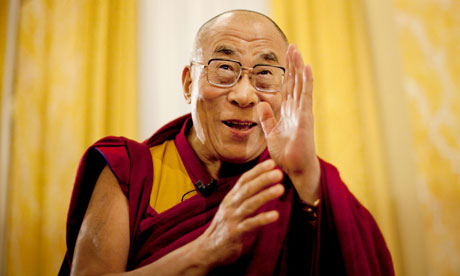 The Dalai Lama was left with grief and regret about his responsibility for the man's death. But when a journalist so taken aback by this story asked him, "How did you ever get rid of that feeling?" the Dalai Lama paused and then responded: "I didn't. It's still there. I just don't allow it to drag me down and pull me back."
Pema Chödrön uses this story to illustrate the concept of "shenpa" - which she describes is the emotion, or quality, of "getting hooked" and our habitual reactions to it. She explains that the key is to learn to see clearly when we get hooked (the "itch" as she calls it) so that we can refrain from our reactive behaviors (the "scratching") that only prolong suffering.
The story caught me on so many levels. First-- the Dalai Lama still suffers? Though there's a part of me that intellectually knows this must be true, part of me is a little shocked. I wonder what the point of the spiritual path is, if someone as enlightened Dalai Lama still knows suffering. Chödrön explains that the strict dichotomy we desire, of here or gone, is misleading, that we can in a sense hold our pain and that of others without suffering from it, while still maintaining a broader vision.
So its not about getting rid of what's painful? Again, intellectually I understand this but on another level, it seems so radical- not to mention impossible. It makes me think of a contradiction I often see in my own experience. Buddhism teaches that the way to be free of suffering is to leave the endless cycle of seeking pleasure and avoiding pain; it cautions against using the dharma itself as a means to this end. I can't help but think- really? How is this possible? Of course this is what led me down this path. I can see clearly my own efforts to gather some ground under my feet, to find answers, stability, comfort, and pleasure. Meanwhile Chödrön teaches that groundlessness is our true state, and efforts to gain ground and uphold our ego- even with the teachings- only prolongs suffering.
I'm not sure where the answer to this question lies. Maybe in more time, greater experience. Maybe in fewer expectations and greater faith in the path itself.